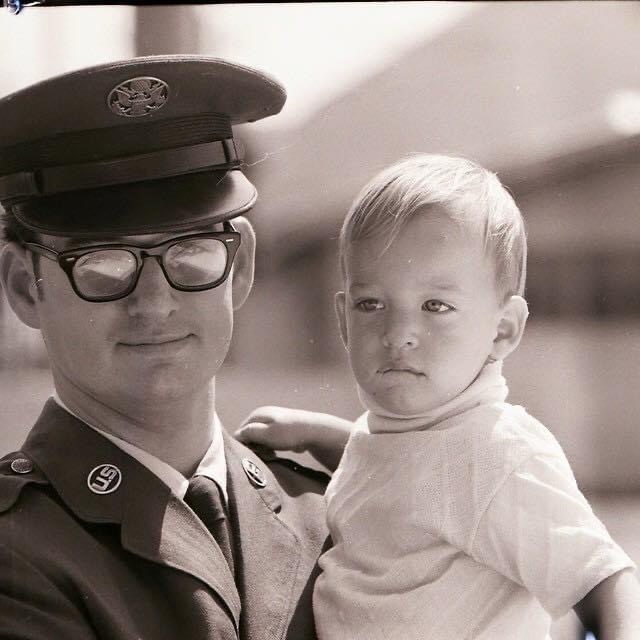
One of my earliest memories of feeling proud of my father’s military service happened on a Sunday afternoon at the Five Seasons Center in Cedar Rapids, Iowa. The Home Builders Show was in town, Gary Lewis and the Playboys were performing, and sometime around four in the afternoon the announcer asked the military veterans in the audience to stand. I always loved when that happened because it meant my dad got to stand.
My father, John Glazier, served eight years in the United States Air Force. We weren’t what I would describe as an overly military family, but we respected the men and women who wore the uniform, and I respected the hell out of what my dad had done. As a kid, I didn’t completely understand what military service during the Vietnam era meant, but I knew that my father had been part of something much bigger than me, and when someone asked the veterans in a room to stand, he was one of them.
The Vietnam War My Generation Inherited
I grew up in Cedar Rapids in the early 1980s, part of the generation that came immediately after Vietnam. The war had ended, but culturally it didn’t seem very far away. World War II had already become the subject of countless movies, television shows, and heroic stories, while Vietnam seemed different, more complicated, and somehow still unsettled.
Maybe that was part of what fascinated me. The Vietnam veterans I saw represented in movies and television seemed different from the soldiers in the old World War II films. Their stories included bravery and sacrifice, but there was also anger, confusion, loss, and distrust.
Then there was the music. The soundtrack of the Vietnam era became some of the same music that eventually inspired me to pick up a guitar: Jimi Hendrix, Eric Clapton, Creedence Clearwater Revival, The Doors, and so many others. That music became inseparable in my mind from the images of the era—helicopters, jungles, protesters, soldiers, hippies, tunnel rats, draft cards and young men carrying rifles thousands of miles from home.
As a kid, of course, I was absorbing a mixture of history and Hollywood. I didn’t completely understand where one ended and the other began. I just knew there was something about that period of American history that fascinated me.
From M*A*S*H to Tour of Duty
Television was a big part of that education. I remember watching M*A*S*H with my parents, and while the show was set during the Korean War, it introduced my generation to a different kind of war story. It could be funny one minute and devastating the next, and underneath the uniforms were frightened, exhausted, and often very young people trying to make sense of what was happening around them.
Then my generation moved into shows of our own. I watched Magnum, P.I., where Thomas Magnum’s service in Vietnam was part of who he was, and The A-Team, whose characters were Vietnam veterans. I remember Quantum Leap touching on Vietnam and its aftermath, and later there was China Beach and Tour of Duty, shows that dealt with Vietnam much more directly.
I absolutely remember watching Tour of Duty. By then, television wasn’t simply referencing Vietnam anymore; the war itself was the setting, and the characters were dealing with the fear, friendships, loss, and confusion that went with it. In some ways, television was growing up alongside my generation as we moved from watching our parents’ war stories to programs dealing directly with the war that had shaped so much of the world we were born into.
Looking back, I think a lot of Generation X absorbed a strange contradiction from the generation before us. We learned that you could respect the person who served while still questioning the institutions that sent them. There was a rebellious streak in the culture we inherited, but it wasn’t necessarily disrespect for the men and women in uniform; sometimes it was exactly the opposite.
Vietnam on the Movie Screen
Movies had an even greater impact on me. There were the classics that came before I was old enough to fully appreciate them, like The Deer Hunter and Apocalypse Now, and then as I got older a wave of Vietnam movies seemed to arrive almost on top of one another. Platoon, Full Metal Jacket, Hamburger Hill, and Good Morning, Vietnam were intense, violent, and unforgettable.
One of the lessons my father gave me, though, was that movies were still movies. I remember him taking me to see Platoon, one of only a couple of movies I specifically remember going to with him, and on the ride before we arrived we talked about what moght be on the screen. My father wanted me to understand that movies like that were sensationalized versions of war and weren’t something to idolize; there were lessons in those stories, but war itself wasn’t entertainment.
That conversation stayed with me, and in some ways I had already received a version of that lesson several years earlier from a movie most people remember for an entirely different reason.
What I Remember About First Blood
When people hear the name Rambo today, they often picture the later films—the machine guns, explosions, and an almost indestructible action hero. But that isn’t the Rambo movie that stayed with me. The first film, First Blood, ends very differently.
John Rambo isn’t celebrating a victory at the end of that movie. He’s breaking down, trying to explain what happened to him and his friends, struggling with the fact that the skills that kept him alive during the war don’t seem to have a place in the life he returned to. He’s trying to understand why people he loved are gone and why the country he served doesn’t seem to understand what he sacrificed.
As a kid, I certainly didn’t have the vocabulary to understand PTSD, trauma, or the difficulties veterans could experience when returning to civilian life. But I understood that scene. This guy was hurting, and the war wasn’t over for him simply because he had come home.
That idea stayed with me far longer than the explosions did.
Respecting Service Without Romanticizing War
As I got older, the distinction between respecting service and romanticizing war became increasingly important to me. There is a difference between honoring the people who served and glorifying the circumstances that put them there. Those aren’t the same thing.
Vietnam was politically and socially complicated, and the people who served came from different backgrounds and had very different experiences. Some volunteered, and some were drafted; some served in combat while others performed essential jobs thousands of miles from the fighting or at bases throughout the United States and around the world. My father was one of those Vietnam-era veterans, serving as an Air Force Avionics Instrument Specialist in Japan as part of a much larger military structure that extended far beyond the borders of Vietnam itself.
That distinction became especially important to me later because when we talk about the Vietnam generation, the conversation often gets reduced to one image: the combat soldier moving through the jungle. Those stories absolutely need to be preserved, but they aren’t the only stories. There were pilots and mechanics, medics and communications personnel, intelligence specialists, support crews, nurses, sailors, airmen, and countless others whose lives were shaped by serving during that era.
Their stories are part of the history too.
Fifty Years Later
More than fifty years have now passed since the end of the Vietnam War, and something bothers me. We regularly celebrate the remaining members of the World War II generation, and rightfully so. When another World War II veteran reaches a remarkable birthday or passes away, the story often receives attention, but I don’t think Vietnam-era veterans consistently receive that same level of recognition.
Their generation is aging too. Every year there are fewer opportunities to sit down with them, ask questions, and let them tell their stories in their own words. Yet rarely do I see a Vietnam-era veteran highlighted, celebrated, or simply given the space to talk about what his or her service meant.
For younger generations, the distance is becoming enormous. Most people who have grown up during the last 25 or 30 years have little frame of reference for what military service during the Vietnam era looked like, not only for those fighting in Vietnam but for the men and women stationed stateside and at bases around the world. For many, Vietnam now exists primarily in textbooks, old photographs, documentaries, and movies.
That doesn’t mean younger generations don’t care. It means someone has to preserve these stories so there is something for them to discover.
Why I Made From Iowa and Back
That is ultimately why making From Iowa and Back: The Vietnam Era became so important to me. It began with my father, John Glazier, and his service during that period, but as the project grew, I realized it couldn’t simply be a story about my father’s generation viewed through my own childhood memories. I needed to listen to the men and women who actually lived through that period and let them explain it themselves.
Not the Hollywood version, not the television version, and not the mythology my generation inherited. I wanted the people themselves. That meant talking with combat veterans, but it also meant talking with Vietnam-era veterans whose service took them somewhere else, because service during that period was not one experience and there wasn’t one Vietnam story.
There were thousands upon thousands of stories. Some were dramatic, some were painful, and some were funny; some involved combat while others involved long hours doing jobs that would never make it into a movie. Some veterans came home carrying memories they rarely discussed, while others simply went back to work, raised families, and continued with their lives.
All of those experiences matter.
The Generation That Changed How America Treats Its Veterans
There is another reason I think this generation deserves our attention. Today, Americans routinely thank veterans for their service, communities recognize veterans at sporting events, concerts and public gatherings, and people organize honor flights, veteran benefits, mental-health programs and homecoming celebrations. None of those systems is perfect, and veterans still face very real challenges, but the public conversation surrounding military service is profoundly different from the one many Vietnam veterans encountered when they came home.
I think part of that change exists because America learned something from the Vietnam generation. Whatever someone thinks about a war, the person wearing the uniform is still a human being. They have parents, spouses, children, and friends waiting for them, and when they come home, they bring their experiences with them.
My generation grew up watching America slowly learn that lesson. Maybe that’s why I still get something out of seeing veterans asked to stand in a crowded room. It takes me back to the Five Seasons Center, to that Sunday afternoon and to being a kid waiting for the announcer to say those words because I knew what would happen next.
My dad would stand, and for a few seconds everyone in the room would see something in him that I already knew was there. He had served, and I was proud of him. More than four decades later, I’m still trying to make sure men and women from his generation get their opportunity to stand.
Only now, instead of waiting for an announcer to recognize them, I have a camera—and I can ask them to tell us their story.